
(Français)
Haiti is a country that freed itself from slavery and colonialism through its own struggle, and it never followed the same path as the former colonizing powers that became capitalist and imperialist nations. During our independence war, our leaders consistently demonstrated their unwavering commitment to the struggle and political philosophy that they championed.
Surrounded by reactionary powers, Haiti’s founder father, Jean-Jacques Dessalines, emphasized our revolution’s internationalist dimension when he lamented in his independence proclamation: “Unhappy Martiniquans! Why can’t I come to your aid and break your chains?”
Historically, Haiti has always been a beacon of liberation, earning it the nickname “Mother of Liberty.”
It is no coincidence that, in 1806, Francisco de Miranda, a pioneer of South America’s liberation from the Spanish Empire, came to Haiti to seek support for Venezuela’s liberation as a part of Gran Colombia. A champion of decolonization, Dessalines supported the expedition, providing it with munitions and even ships. However, he also foresaw Miranda’s failure, telling him: “You don’t fight European colonial domination in America by sitting around a table with the large landowners.”

When Miranda’s compatriot Simón Bolívar succeeded him as head of the anti-colonial struggle to form Gran Colombia, he too sought the help of the influential political power of the time. Following in Dessalines’ footsteps, Alexandre Pétion did not hesitate to support Bolivar’s project, providing him with munitions and even Haitian fighters to overthrow the Spanish Empire’s colonial regime.

These are just a few examples among many. At the Congress of Panama in 1826, to celebrate his victory, Simón Bolívar invited Haiti. This meeting of the newly freed colonies would undoubtedly have sung the praises of the revolution in Haiti, which represented an undeniable force at the time.
But the United States categorically opposed Haiti’s presence, threatening to boycott the congress if Haiti were invited. In response, the organizers excluded Haiti to appease the United States, thus foreshadowing the policy of U.S. hegemonic domination over the continent.
Since that time, Haitians should understand: a monster has been raging in the region, unable to tolerate the continued existence of the revolutionary virus that Haiti represented in America. Indeed, the United States never approved of the Battle of Vertières nor our 1804 revolution, which put an end to the barbaric slave trade and chattel slavery in general. And for this historical reason, in the eyes of Washington, Haiti was a country to be isolated, harassed, and punished relentlessly.
However, Haiti never shared the same political philosophy as the aggressor countries, especially those that practiced slavery. The Haitian Revolution’s ideals rested on a progressive policy, benefitting all the oppressed, particularly African Americans, who still suffered under slavery’s horrific yoke. “All African Americans who set foot on Haitian soil will become free,” declared Dessalines.
It took 61 years after our liberation for the United States to finally abolish the abominable system of enslaving Black Africans through ratification of the 13th Amendment to the Constitution on Dec. 18, 1865. Nonetheless, it soon established an apartheid-like racial segregation against them, demonstrating that they had never considered these people of African descent as human beings. The extraordinary struggle against the “Jim Crow” policies that brought forth figures such as Martin Luther King Jr., Rosa Parks, Malcolm X, and the recently deceased Jesse L. Jackson.
Colombian President Gustavo Petro, despite his sometimes blatant contradictions and shortcomings regarding U.S. imperialism, had the courage to speak at Reverend Jackson’s funeral and address the issue of the Black struggle, while placing the Republic of Haiti, a pioneer in this area, on an unprecedented pedestal.
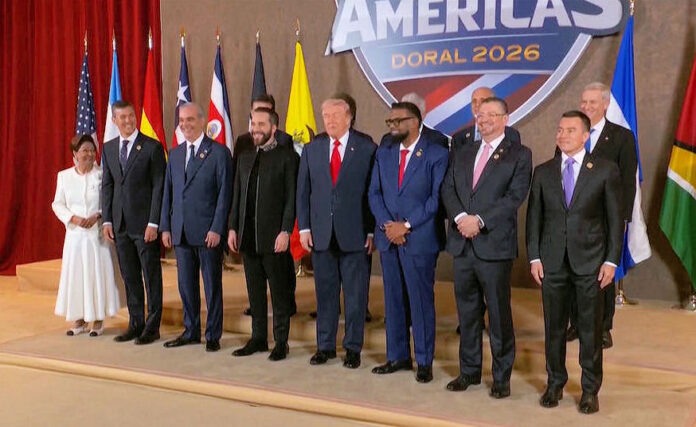
Unfortunately, on that same day, Sat., Mar. 7, 2026, the invader, the oil pirate, the President of the United States of America, Donald Trump, organized a grotesque summit in Doral, Florida, with 12 puppets to announce the “Shield of the Americas” coalition, an event to which Haiti was not invited. For most Haitians steeped in a colonized mentality, this was a disgrace for Haiti. A good example of this reaction is that of journalist Nancy Roc, who wrote: “Haiti has been left out in the cold: progressively marginalized in the continent’s new security architectures and deprived of a diplomatic strategy.”
We take the opposite view. The international situation is currently marked by sensational, brutal, murderous events being driven by the United States. Haiti is a victim of this imperialist nation which holds it hostage, denied the right to freely determine its own destiny. Haiti’s absence from this “Shield of the Americas” event should be considered a victory rather than a defeat. On the contrary, its presence there would have been a grave insult, an affront to the Haitian nation.
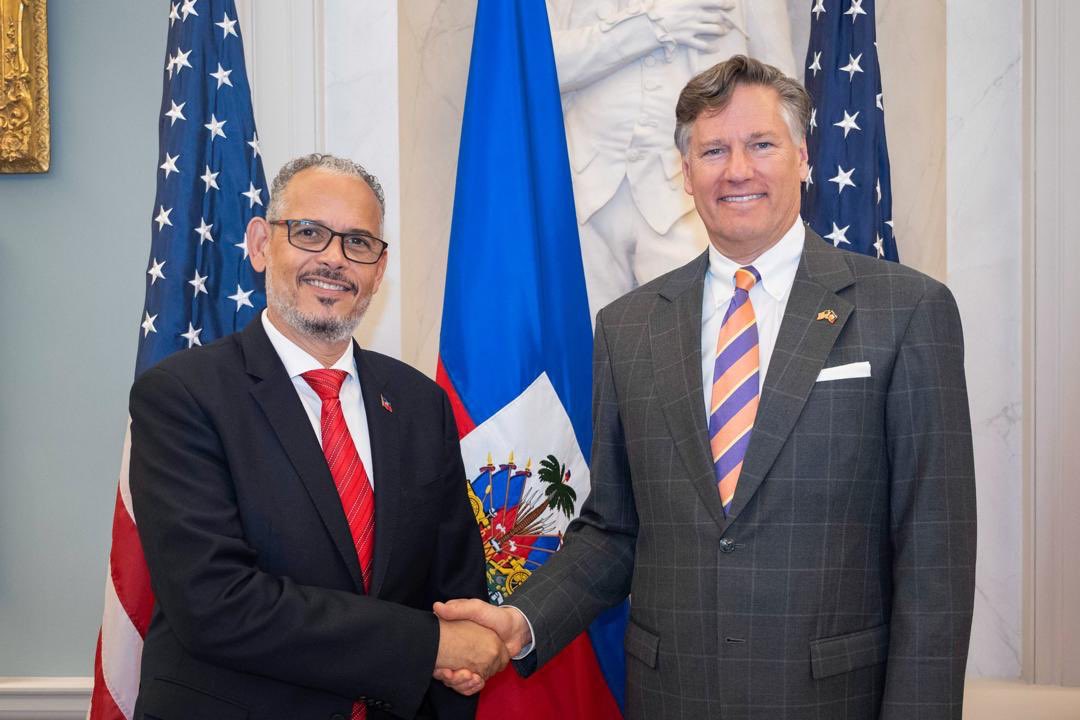
The de facto Prime Minister, Alix-Didier Fils-Aimé, a puppet of the West, would undoubtedly have liked to participate in this parade of zealous and evil tools, unconditionally subservient to North American imperialism, in order to flaunt his allegiance to it. But it would have been a disgrace for our country to be complicit in organizing the fascist terror advocated by Trump to disrupt and destabilize other countries in the region, particularly those that refuse to obey his dictates, under the false pretenses of fighting drug trafficking.
What is at stake is a tacit attempt to annihilate the hope of all peoples, to break the will of all progressive opposition, and to overthrow all governments that embody the ideals of justice, national independence, and the establishment of a society free from all forms of exploitation.
It is, of course, understandable that the Dominican Republic now appears as one of the United States’ key partners in the Caribbean, while Port-au-Prince is gripped by a permanent crisis. Haitians must remain proud of their history as a liberating people, a rebellious people, an indomitable, defiant people. They are the only victims of a U.S. military occupation who never culturally adapted to the occupier’s national sport: baseball. Our growing crises, which persist and continue to severely compromise any possibility of change, are part of the relentless struggle waged against the Haitian masses. We will overcome them sooner or later!
These practices are not new in American political life. But this is the first time they have been used on such a vast scale. They prove that our actions in 1804 were not in vain. Similarly, the Cuban Revolution of 1959 and Venezuela’s Bolivarian Revolution in 1999 take on their full meaning and role in the face of humanity’s greatest enemy. These countries are targeted by imperialism, and that is why they are both going through one of the greatest crises in their history. Haiti is, and will remain, a striking example.
No solution is possible in Haiti as long as a puppet government maintains its grip on power thanks to an all-powerful imperial force. This imperialist system cannot be reformed; like slavery, it must be destroyed! The Haitian people will triumph!