
The triumph of Haiti’s first revolution resulted from the union of two distinct classes.
The first was Haiti’s freedmen (affranchi), whose foremost political leaders included Alexandre Pétion and Henri Christophe. This class generally owned landed property, but because many of its members were the children of slave owners and enslaved mothers, they did not enjoy all the rights of French citizenship. Hence their primary demand was for “égalité” (equality).
The other group, much larger, was the masses of former slaves, the bossalles, many of them born in Africa, whose foremost leader was Jean-Jacques Dessalines. Either they, their parents or grandparents had been enslaved, and, with Napoleon seeking to reestablish slavery a decade after its 1793 abolition in the colony of St. Domingue, their principal call was for “liberté” (freedom).
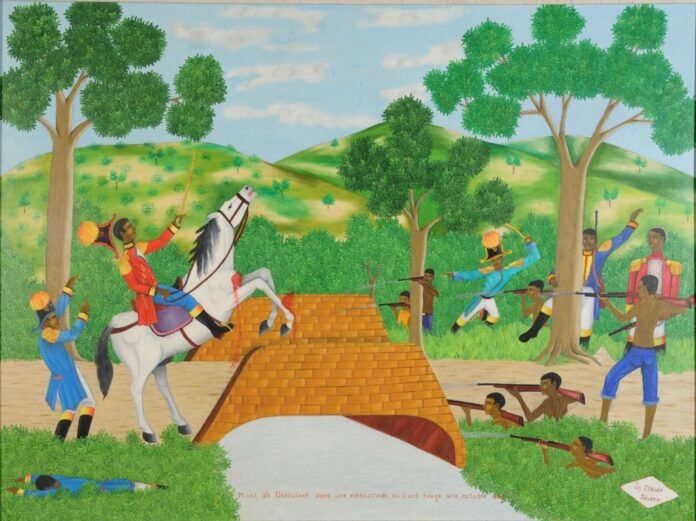
Dessalines proclaimed Haiti’s independence from France on Jan. 1, 1804, but just over two years later, through a wide-ranging conspiracy, on Oct. 17, 1806, the affranchi leaders assassinated Dessalines, which dramatically changed Haiti’s course.
Dessalines had challenged the affranchi’s power, primarily through his nationalization of land. His guiding principle was: land belongs to its tiller.

From the affranchi coup d’état, two ruling classes emerged. The grandon, or big landowners, and the comprador bourgeoisie, which controlled the import and export of goods to and from Haiti.
Peasants worked the land, paying a tithe to the grandon, much like medieval European serfs paid their nobility. The comprador bourgeoisie then marketed those products to the world capitalist system. Hence Haiti’s system was known as semi-feudalism.
For this reason, Dessalines’ assassination was not merely a change of leader.
It produced three structural shifts:
1. Dissociation between popular sovereignty and the state apparatus.
2. Privatization of power by politico-military factions.
3. Establishment of permanent internal competition for control of the State.
This was not an ordinary political transition, but a transformation of the principle of legitimacy — a civilizational turning point. Power ceased to be based on insurgent unity and became based on institutional control.
The people were no longer their own masters. They became administered. Even if the regimes differed, the underlying semi-feudal structure remained the same: the state began to exist to preserve this system, and give advantages to whichever ruling class rival – grandon or comprador – held the Presidential Palace.
Under Dessalines, coercion was justified by national survival against hostile colonialist empires. After 1806, it became administrative. Power collected, organized, and disciplined — without relying on continuous popular mobilization. The implicit contract was transformed: legitimacy no longer stemmed from active sovereignty, but from the capacity for governance.

1804: the people were the source of legitimacy. 1806: the people became the object of governance. This is where the matrix of the semi-feudal bourgeois state is born. I call it the Affranchi State.
The indemnity imposed by France in 1825 does not create this matrix. It consolidates and locks it in. It reinforces external dependence and the centrality of customs revenues. The State learns to survive through international flows rather than through a broadened domestic productive base. The less it depends fiscally on the people, the less it owes them politically.
Changes of presidents, coups d’état, and civil wars do not alter this architecture. The State becomes a prize to be captured. Control of power guarantees access to resources. In a fierce rivalry, the grandon and comprador fought for primacy, which conferred advantages to whichever faction held State power. Society remains peripheral to the decision-making structure.
This is not a problem of race. This is not a regional problem. Black, mulatto, military, and civilian leaders have succeeded one another. The constant variable is not skin color. It is structural. The Affranchi State could be administered by actors from any and all social strata, but it served the interests only of the grandon and the comprador. What matters is adherence to the model.
As long as the architecture remains, the actors change, but the logic persists.
In the 20th century, the U.S. occupation did not create the matrix. It rationalized it, by increasing centralization and bureaucratic institutionalization. The U.S. Marines strengthened the administrative center and conferred more political power and trust to the ruling class’ comprador faction. (There were both economic and racist reasons for this favoritism.) The form evolved, the logic persists: the State became more divorced from the popular masses.
In contemporary times, international financial dependence prolongs this configuration: external aid, remittances from the diaspora, predominance of customs revenue. The State still does not primarily rely on a broad national productive tax base. It can therefore survive despite popular distrust. Function despite territorial fragmentation. Publish macroeconomic indicators while society crumbles.
This is not the absence of a State. It is a detached State.
Ultimately, the Affranchi State is a political apparatus that, after 1806, ceased to be the direct expression of an insurgent popular sovereignty and began to reproduce itself independently of it. It can change its leaders. Change its constitution. Change its ideology within feudal and bourgeois parameters (e.g. Duvalier vs. Déjoie). But it retains one constant: it is not structurally dependent on the permanent fiscal and productive consent of the Haitian people.
The North-South divide following Dessalines’ assassination was the visible symptom. The ontological rupture, however, was invisible. Since 1806, the foundation of legitimacy, the relationship with the people, and the mode of power reproduction have been transformed. This matrix runs through the 19th century, the U.S. occupation, authoritarian regimes, fragile democracy, and the contemporary period.
In the past 57 years, since the visit of Nelson Rockefeller in 1969, the grandon have gradually begun to disappear. In the 40 years since Jean-Claude Duvalier’s fall in 1986, their demise has accelerated. Haiti is no longer an agricultural neocolony surviving off the toil of its peasant serfs (deux moitiés). It has been converted into a giant prison camp for wage-slave labor assembling clothing and electronics for the U.S. empire.
The Affranchi State was born of a rupture. It became a structure.
The comprador bourgeoisie, in its vast majority, no longer sells overseas the cheap coffee, sugar, cacao, cotton, sisal, and bananas that the peasantry once produced. Instead, it taps the inexpensive labor power of the peasantry’s children and grandchildren, a teeming proletariat and lumpen-proletariat who live in the cities’ vast slums to work in the “transformation industries,” putting together duty-free merchandise exclusively for export. Only the labor comes from and stays in Haiti.
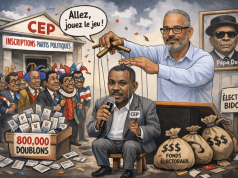
Therefore, today, Haiti’s comprador bourgeoisie is a contractor for U.S. imperialism and hence the sole master of the Affranchi State. De facto Prime Minister Alix Didier Fils-Aimé is its archetypal representative.
It is not a question of color. Nor a regional issue. The Affranchi State has a specific architecture. As long as the architecture remains, the actors change, but the logic persists.
The Affranchi State was born of a rupture. It became a structure. And it continues to adapt, serve its foreign masters, and reproduce.
But, the affranchi must beware, and they know it, which is why they are running for help to their masters. The descendants of the bossalles, Dessalines’ children and avengers, are once again rising.