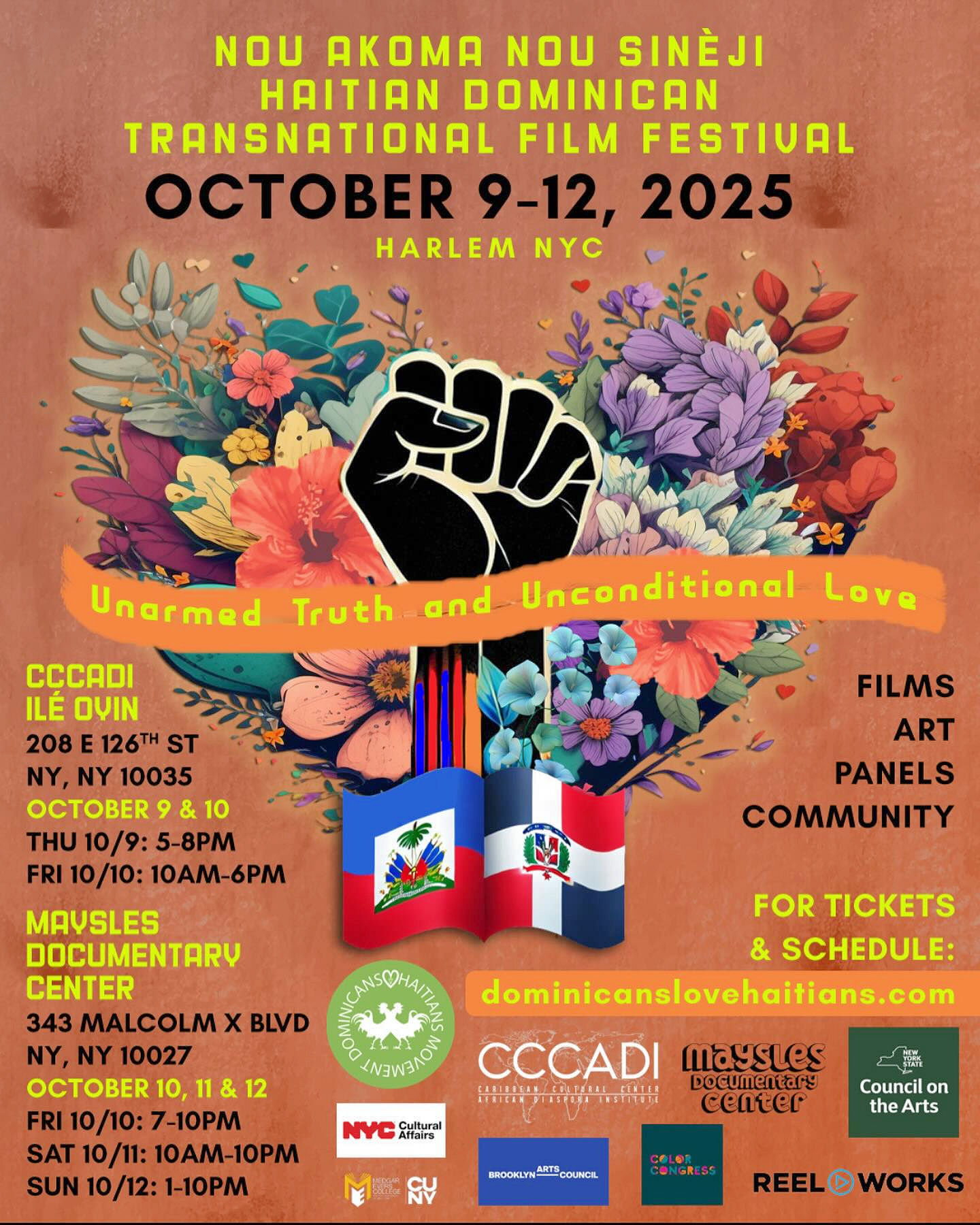
The “Dominicans Love Haitians Movement” presented its third annual film festival last week in Harlem with a selection of documentary, short, and feature films that illuminate the deeper dimensions of Haitian and Dominican identity as well as the tensions and bonds that have grown out of the intertwined histories of the two neighboring nations.
The opening words of its official title – “Nou Akoma Nou Sinèji Haitian Dominican Transnational Film Festival” – roughly translates to “we have love, tolerance, goodwill, and synergy,” and that spirit was conveyed through the four days of films and workshops.
The festival kicked off on Oct. 9 at 125th Street’s Caribbean Cultural Center (CCCADI) with three short films. The first was the documentary The Making of a Matriarch, third-generation Dominican-American Vanessa Alexandra Cruz’s poignant “love letter to grandma,” illuminating the resilient migration narrative that defined her family, a deeply personal journey into memory, lineage, and womanhood.
Then there was Haitian-American Lunise Cerin’s Victorine, whose subject is a Haitian-American dancer who returns to Haiti after her mother’s death, embarking on a profound meditation on grief, memory, and the pull of ancestral roots.
Finally, there was Anthony Rojas’ Papi Chulo, a sharp, witty exploration of masculinity, pride, and love in the diaspora. The protagonist, Yani, a charismatic Afro-Dominican, experiences a tumultuous day in Manhattan’s Washington Heights neighborhood after his girlfriend evicts him, as he struggles to regain both love and dignity.
The festival’s second day was devoted to workshops, networking, and a panel, at CCCADI, all capped off at the Maysles Documentary Center on Lenox Avenue with a feature by Haitian director Joseph Hillel, Koutkekout (At All Kosts), about the resistance and courage of Haiti’s people, told through history, stories, poems, and performances interwoven between fiction and reality.
The festival’s remaining two days saw three feature documentaries and 16 shorts (including the opening night’s three films). Nostalgia echoes through these narratives, evoked by recollections of family, identity, and oral tradition.
“I carry my heritage into the work I do with the cultural movement of ‘Dominicans Love Haitians,’” said Ana Maria Garcia, the organization’s chairwoman. Despite its name, the movement aspires not for unanimity but for mutual understanding, where opposing views can coexist without acrimony. Garcia invites us to watch and listen to stories of diaspora empowerment but also underlying animosities, which sometimes sprout up even in our own families with mixed cultures, races, and nationalities. Genuine dialogue, Garcia notes, reveals the magic residing in every individual, a magic that hatred blots out.

Over its four days, the festival probed the essence of heritage and inherited values with films and discussions which prompt examination of the subtle forces, tradition, gender, familial expectation, and unspoken codes that shape identity across generations. From both feminine and masculine vantage points, the festival encourages critical consideration of what we inherit: Which beliefs do we preserve, which do we question, and what do we relinquish?
Ultimately, these stories ask: How does heritage sculpt us and inform our outlook? Which values, whether conscious or unconscious, undergird our shared identity?
At the end, the festival awards the films that catalyzed deeper conversations about what unites and divides us. Its two highest distinctions are the Maroon Jury Award and the Maroon Create Dangerously Award. Both draw inspiration from the Maroon communities, Africans and indigenous peoples who liberated themselves from slavery and forged new societies in remote mountains across the Caribbean and Americas.
This year, Pierre Michel Jean received the Maroon Create Dangerously Award for L’oubli Tue Deux Fois (Twice Into Oblivion), an artistic revisiting of Dominican dictator Rafael Trujillo’s 1937 massacre of over 20,000 Haitian immigrants then living in the Dominican Republic. Daphné Ménard, a Haitian theatre director, brought together actors from both parts of the island to work on this creative project that demanded both Haitians and Dominicans to summon up the darker realms of their histories.

The “Create Dangerously” Award, inspired by Albert Camus’ 1957 essay of the same name, honors artists who challenge comfort, censorship, and convention to reveal vital truths; those who wield art as moral resistance, rejecting apathy and complicity in the face of injustice. These awards recognize cinema as both rebellion and remembrance, where storytelling becomes a means of survival and an act of resistance.
The Maroon Jury Prize honors films that exemplify resistance, cultural resilience, and liberation. This year, Lunise Cerin won the prize for Victorine in the short story category, Vanessa Cruz won for The Making of a Matriarch in the short documentary category, and Jose Maria Cabral won for the feature documentary La 42 (42nd Street), a kinetic and shocking look into the wild Dominican urban landscape along a 600-meter strip of Santo Domingo’s 42nd Street.
These awards highlight filmmakers who confront oppression, break historical silences, and reclaim their identities. They represent the festival’s mission: to highlight the radical imagination of the Haitian and Dominican diaspora and to recognize artists who, through creativity, courage, and love, are forging new paths towards continued liberation.
“Three years immersed in Dominican culture and history have revealed to me the island’s intricate realities,” said Anjanette Levert, a “Dominicans Love Haitians” board member. “My experiences in the Dominican Republic, complemented by travels to Haiti, have profoundly expanded my understanding. Nevertheless, I am dismayed by the Dominican government’s severe immigration policies, which perpetuate deprivation and undermine the shared heritage of Hispaniola… Colonizers expertly fostered division and disenfranchisement, exploiting historical ignorance until falsehoods become solidified as accepted truths.”
Through the cultural movement “Dominicans Love Haitians,” films send out a clarion call to break the cycles within heritage and family traditions that no longer serve us. As a generation, we have a responsibility to consciously assess what we inherit and then participate in reshaping our future.