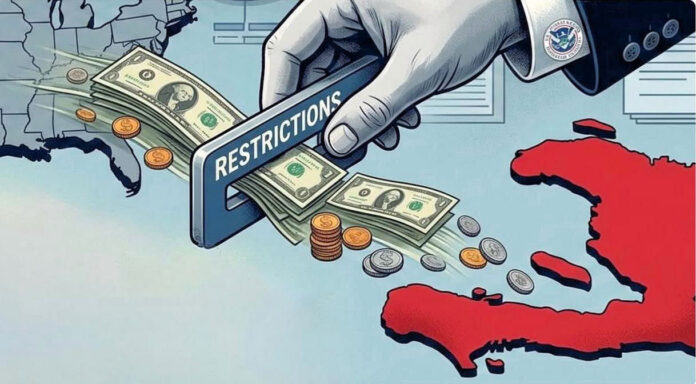

If the United States truly decides to restrict remittances to Haiti, my position is simple: I support this decision.
I speak here as a Haitian. Not as a U.S. supporter. Not as an anti-immigrant activist. As a Haitian. And I will explain why.
For decades, Haiti has not been developing its economy. It has been developing its exile.
We have transformed the “brain drain” into a national architectural construct. We export our talent, our doctors, our engineers, our young graduates. We import their dollars.
It is a model of dependency. A model where human capital leaves the country, and where remittances replace the state’s responsibility.
I do not support this model. I never have.
However, the diaspora is not to blame. The system is. I do not condemn the diaspora. I don’t condemn families who survive thanks to remittances.
But let’s face the truth: When remittances represent approximately 20% to 25% of Haiti’s GDP, according to the World Bank, it means our economy isn’t producing enough. This makes Haiti one of the most remittance-dependent countries in the world. Our survival depends on external aid.
This means our state isn’t taking responsibility. A country cannot build its sovereignty on a constant lifeline.
This isn’t marginal aid. It’s a backbone.
Every year, we lose doctors, nurses, engineers, entrepreneurs, teachers, and police officers.
This isn’t individual migration. It’s a systemic extraction of human capital.
It’s called “brain drain.” I call it a hemorrhage.
A country that loses its brains and compensates with remittances doesn’t develop. It survives. For aid to help us, it must help us become self-reliant.
A country that breathes thanks to lungs located abroad never learns to strengthen its own.
I am not celebrating suffering. I am asking the taboo question: Does the life support prevent healing?
In other words, does the artificial maintenance of this model prevent structural breakdown?
So let’s ask the question everyone wants to hear: If transfers are restricted, what happens?
Yes, there will be a shock. Yes, it will be difficult. Yes, families will suffer.
But the real question is this: How long will we continue to stabilize failure? And if transfers suddenly cease, who falls first? Because as long as the money keeps flowing: The state is never forced to become a state. The elites are never forced to be held accountable. The model never changes.
If restricting remittances forces Haiti to rethink its economic model, then this shock could become a turning point.
To be clear, I do not support punishing families. I support ending a parasitic economic model. I support ending a system where we export our brains, import dollars, and call it a national strategy.
It is not a strategy. It is organized dependency.
This model has turned exile into an industry. It has allowed the elites to never reform. It has replaced the state with the diaspora. It has anesthetized the break.
Now, can we turn this lifeline into leverage?
Yes, a more powerful alternative would be: an internal economic transformation plan, a strategy for the diaspora’s political organization and a mechanism of conditional pressure. This would be a conscious break. Not an external sanction.
Important clarification: I am not speaking here to endorse anti-Haitian rhetoric. I am not speaking to criminalize migrants. I am speaking to say this: A country cannot indefinitely breathe thanks to the lungs of its exiled children. At some point, it must learn to breathe on its own, as it has in the past.
If this U.S. decision is confirmed, then we have two choices: Panic and blame. Or use the shock to rebuild.
I choose reconstruction. Because I refuse to allow Haiti’s future to be based on the brain drain and the export of its youth. I refuse to allow our economic model to be based on exile.
Haiti must not be a country that produces migrants. Haiti must become once again a country that produces wealth, stability, and dignity. If this measure forces us to change our model, then yes, I support it. Not out of submission. But out of clear-sightedness.
And I address this question to those who are against it: Are we preventing the birth of the country we claim to love?