February 7 now marks Haiti’s highest and lowest historical moments in recent history.
In 2026, it saw the dissolution of Haiti’s Transitional Presidential Council (CPT) and, under the muzzles of Trump administration gunboats, the concentration of all executive power in the hands of a single Haitian bourgeois businessman: de facto Prime Minister Alix Didier Fils-Aimé. As the New York Times reported on Feb. 8: “The country had never had a power vacuum this severe.”
Exactly 40 years earlier to the day, Haitians were rejoicing at the overthrow of the three-decade old Duvalier dictatorship, which is why Feb. 7 has become the traditional and official date for the transfer of democratically elected power in Haiti.

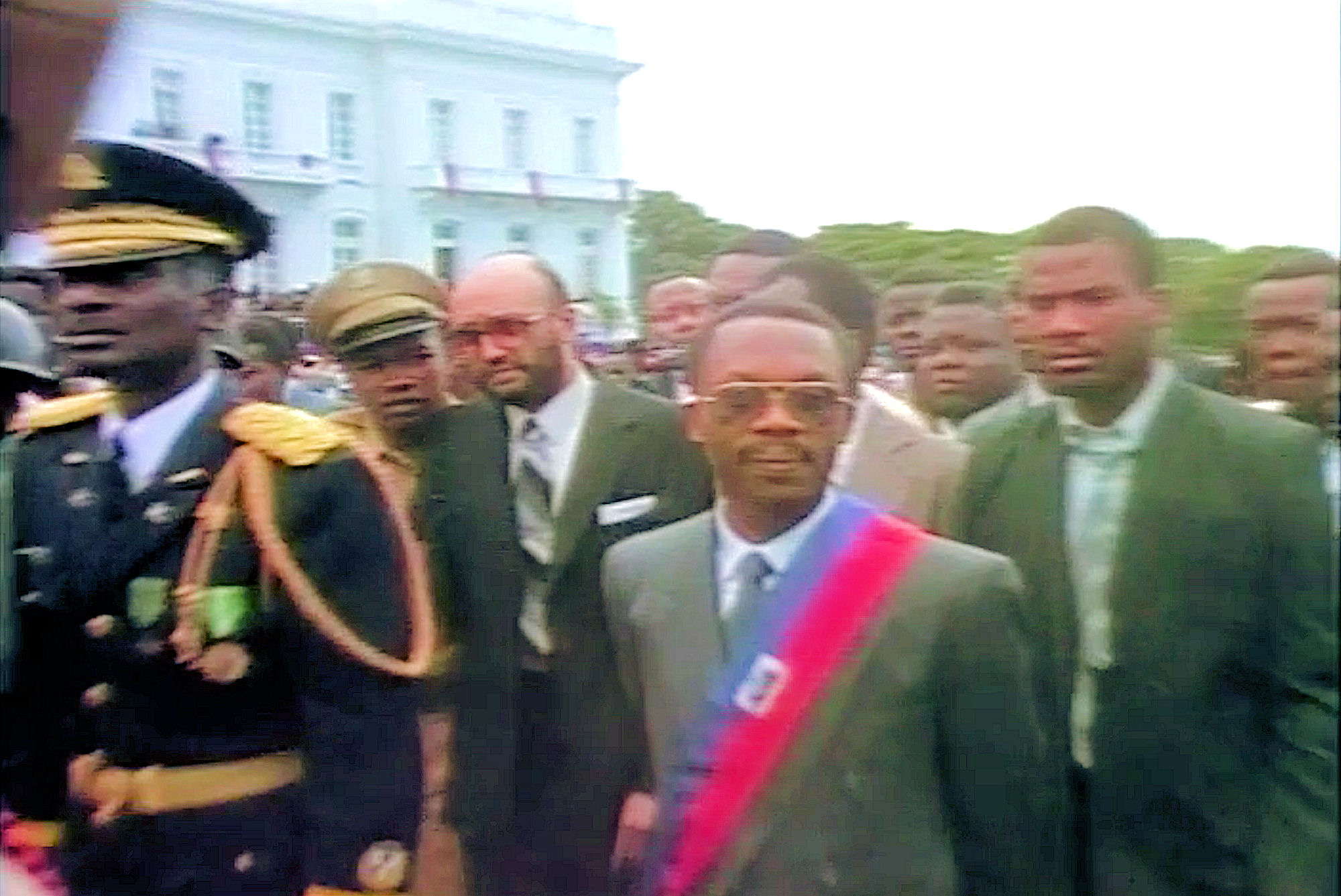
Photo: Haiti Films
In 1986, Haitians around our Caribbean nation and throughout its diaspora held immense hope for Haiti’s future. From rural villages to cities such as Port-au-Prince, Gonaïves, and Cap-Haïtien, Haitians mobilized mass demonstrations, as well as in New York, Montreal, Miami, and Washington, DC, to demand democracy. Many viewed the moment as the beginning of a “Second Haitian Revolution” that would correct the social, political, and economic failures that followed the first one in 1804.
There followed five years of sharp political struggle and coups d’état, but they nonetheless culminated with the victorious Feb. 7, 1991 inauguration of President Jean-Bertrand Aristide, Haiti’s first head of state elected by a nationwide popular vote. It was a period of delirious joy and optimism. Thousands of diaspora Haitians flooded back to the country, and Aristide declared “Haiti’s second independence.”
However, the U.S., along with France and Canada, had already begun a major counteroffensive to push back against the burgeoning political revolution in the upstart nation. Similar to the example Haiti set in 1804, Aristide’s unexpected ascension to power fired the imagination of all Latin America, sparking the “Pink Tide” which spread throughout the hemisphere.
At that time, there was a major geopolitical shift occurring in the world. The Cold War was ending as the U.S. eventually wore down and dissolved the Soviet Union, establishing itself as the sole global superpower. Some U.S. intellectuals declared that capitalism had finally vanquished communism, thus bringing “the end of history.” It was understood that any countries which dared to defy Washington’s agenda would be crushed.
But Haiti was born and is defined by defeating Napoleon’s France, the superpower of the early 19th century. Thus, at the end of the 20th century, the “rebel country” Haiti was not afraid to stand up against U.S. imperialism.
Neoliberalism takes Haiti and the world by storm
In the late 1980s, U.S. capitalists were on the march worldwide. They descended on many neocolonies, forcibly imposing neoliberal reforms such as privatization, deregulation, austerity and other measures to reduce government spending, labor market flexibility (i.e. anti-union campaigns and union busting), and enacted laws that were favorable to employers, especially foreign ones.
Politically, they began to phase out dictatorships such as the regimes of Duvalier in Haiti (1986), Marcos in the Philippines (1986), the Argentine military juntas (1983), Chile’s Augusto Pinochet (1990) and many others. This paradigm shift from strong-man regimes to “demonstration elections” (as Edward S. Herman and Frank Brodhead called them in their seminal 1984 book) engineered by semi-governmental organizations like the National Endowment for Democracy (NED), a spin-off from the CIA, began with the “human rights” campaign launched by President Jimmy Carter in the late 1970s. Washington sought to accompany their deepening investments in the Global South with the semblance of bourgeois democracy to reduce guerrilla insurgencies and rampant, arbitrary caudillo corruption, protect corporations’ rights, promote economic growth, and generally stabilize their rebelling vassal states, where the masses were groaning under massive debt and inspired by the victorious national liberation struggles in Cuba, Nicaragua, Angola, Mozambique, Zimbabwe, and Vietnam.

This push for democratic reform was compatible with capitalist globalization. Capitalist pundits and analysts marketed neoliberal policy as “democratization” that would enable countries to function more efficiently, reduce government waste, and permit business leaders to innovate new technologies, leading to “economic prosperity for everyone.”
However, this top-down economic model and neoliberal reforms produced devastating outcomes for working-class communities in both the neocolonies and the United States. The result was increased exploitation, wage stagnation, erosion of public services, weakened labor protections, and widening inequality as the wealthiest few reaped fantastic profits, while working families faced increasing economic insecurity which fueled political instability.
Neoliberalism destroys Haiti’s rural economy
After Duvalier was ousted, the Haitian economy collapsed. Municipalities went bankrupt, leaving state employees unpaid while debts piled up. The International Monetary Funds (IMF) stepped in, pretending to help Haiti with its debt crisis but actually making things worse.
First, the IMF demanded government austerity: the firing of state agency employees and the cutting of the meager social services that the government had provided to its citizens. Second, it demanded the privatization of all public enterprises: the flour mill, essential oils plant, cement factory, electric power authority, telephone company, and others. Third, the IMF called for the removal or drastic lowering of all tariff barriers protecting primarily Haitian agricultural production, above all (as we will see) rice farmers and sugarcane-based industries. After that neoliberal “free trade” adjustment, cheap U.S. imports were dumped on the Haitian market, virtually tax free. Prior to this neoliberal “structural adjustment,” Haiti had been largely self-sufficient in food production and even exported agricultural products.

Take the example of HASCO, once Haiti’s state-run sugar mill, which allowed farmers to grow sugarcane and sell it to the government for stable livelihoods. After Jean-Claude Duvalier was forced out, General Henri Namphy’s neo-Duvalierist junta sold the sugar mill to the Mevs family, one of the wealthiest in Haiti’s tiny bourgeoisie. The Mevs had no intention to invest and resuscitate Haiti’s sugar industry but instead shut down the mill and began importing cheap sugar from the U.S. and the Dominican Republic for quick and easy profit, leaving thousands of cane cutters and farmers to fend for themselves. Haiti’s sugar industry, once its pride, has never recovered.
A similar story occurred with rice, one of Haiti’s staple foods. The country used to produce and even export its own rice. Forty years ago, the central Artibonite Valley was a vibrant patchwork of emerald green paddies, producing very high quality rice. But with tariff walls struck down after 1986, cheap U.S. rice flooded the Haitian market, selling at prices lower than local rice. Haitian farmers using baskets and hoes could not compete with the mile-wide rice combine harvesters used by agro-industries in Arkansas. Neoliberal policies devastated Haiti’s farmers causing Haitians to be increasingly dependent on food imports, thus hungrier and facing chronic budget deficits.
Millions forced from the countryside to the cities
The award-winning 1983 documentary Bitter Cane, directed by Ben Dupuy and Kim Ives, documents how neoliberal policies destroyed Haiti’s rural economy and drove millions to flee overseas in boats or seek to survive hawking, hustling, or working for peanuts in Haiti’s growing urban shanty towns. To take advantage of this vast and growing pool of cheap labor, foreign capitalists, working with Haiti’s comprador bourgeoisie, set up sweatshop assembly factories in tax-free industrial parks where workers were paid a mere $2.64 a day.
Years later, Kim Ives interviewed Bill Clinton in a United Nations hallway in March 2010, where the former U.S. president famously claimed that Washington’s planners were just trying to help Haitians “skip agricultural development and go straight into an industrial era. And it’s failed everywhere it’s been tried. And you just can’t take the food chain out of production. And it also undermines a lot of the culture, the fabric of life, the sense of self-determination… We made this devil’s bargain on rice. And it wasn’t the right thing to do.”
Indeed, Haiti’s sweatshop workers were even more exploited, oppressed, and caught in a persistent cycle of poverty. Neoliberal “reforms” trapped them and their families in deeper misery rather than liberating them.
In 1983, Port-au-Prince had about 500,000 residents, but, 20 years later, by 2003 the population had ballooned to more than 3.2 million, according to the Institut Haïtien de Statistique et d’Informatique. The Haitian government made no attempt at strategic urban planning for the growing population, failing to build adequate roads, sanitation, or other infrastructure. People constructed informal homes, with no building code enforcement, on unsafe land in the ravines, flood plains, and steep hillsides. This vulnerability contributed to the catastrophic toll of the 2010 earthquake, which killed an estimated 46,000 to 84,000 people, most of them in Port-au-Prince. Many of these deaths could have been prevented had the Haitian government even a minimum of urban planning or code enforcement.


With the Haitian state shirking its duty to provide basic infrastructure and services for its citizenry, foreign non-governmental organizations (NGOs) filled the void, making Haiti the nation with the most NGOs per capita in the world.
Ironically, during the earthquake response, many NGOs avoided poor neighborhoods after U.S. and Haitian authorities labeled them too dangerous or inaccessible, causing increased suffering due to the dependence they had built.
Urban “gangs” fill the void left by the absent state
Urban abandonment created a vacuum for neighborhood armed groups to emerge in Port-au-Prince’s growing slums. In the Haitian and international bourgeois press, these groups are always referred to as “gangs,” a word choice designed to imply that they are all criminal, which is untrue.
Neighborhood armed groups did not first emerge under President Jovenel Moïse. Many trace their roots back decades to the days after Duvalier’s 1986 fall, when communities crudely armed themselves to fight against reprisals and forays of the disbanded Tonton Macoute paramilitary force.
Under Jean-Bertrand Aristide’s presidencies in the early 1990s and 2000s, many became the shock troops – called chimères (ghosts) – to fight the bourgeois and imperialist destabilization campaigns against the Lavalas government. After the 1991 and 2004 coups, the groups fought with the putschist Haitian police, army, and paramilitaries (1991-1994) or foreign occupation troops (2004-2006), primarily in neighborhoods such as Cité Soleil and Belair.
President Michel Martelly (2011-2016) also financed and dealt with armed groups to reinforce his government and suppress opposition.
During all this time, Haiti’s bourgeoisie armed and funded groups to protect their warehouses, factories, and land, or to support the politicians they wanted to see elected. Once in power, the politicians did the same. This often resulted in battles between rival neighborhoods affiliated with different politicians or businessmen or power struggles within neighborhoods.
From 2017 to 2021, opposition formations like the Democratic Popular Sector (SDP) of André Michel formed and funded armed groups – both within the population and the police – to destabilize President Jovenel Moïse.
But “gangs” only burst into the headlines after May 2020 when former policeman Jimmy “Barbecue” Cherizier announced the formation of the G9 Family and Allies, an alliance of neighborhood armed groups dedicated to uprooting crime in their communities and fighting among each other, as politicians and bourgeois had encouraged. He said that G9 armed groups would no longer do the bidding and fight the battles of politicians and the bourgeoisie. The coalition was seeking revolutionary “system change” in Haiti, he said.


The bourgeoisie quickly formed the G-Pèp as a counter-force to the G9, and for three years the two coalitions fought bitterly, until Cherizier and other G9 leaders prevailed upon the G-Pèp groups to join with them in a united front called Viv Ansanm (Live Together) to fight de facto Prime Minister Ariel Henry and the system he defended. Despite being launched in September 2023, the Viv Ansanm alliance only became fully operational on Feb. 29, 2024, when it prevented Henry from returning to Haiti after a trip to Kenya to sign an agreement for the deployment of yet another foreign military invasion.
Today, that 2024 force – the Multinational Security Support (MSS) Mission – has been supplanted by the Trump Administration’s Gang Suppression Force (GSF), but, more importantly, Erik Prince’s Vectus Global mercenary army which is working closely with the Haitian National Police (PNH) to carry out terribly deadly and indiscriminate drone and death-squad attacks on popular neighborhoods around Port-au-Prince, wantonly killing hundreds of innocuous civilians and leveling whole neighborhoods.
Sadly, this hecatomb of Haiti’s poor has gone entirely unreported by almost any major media other than Haïti Liberté,which has published the details of some of the worst massacres. But the population is increasingly terrorized, and reporting on the slaughter is becoming very difficult.
Since the Viv Ansanm’s emergence, Cherizier has been calling for a “national dialogue” of all Haitian sectors around a table to end the dysfunction and violence wracking Haitian society, but the U.S. Embassy has vetoed any moves in that direction. This prohibition against talks and compromise was reinforced in May 2025 when Marco Rubio’s State Department designated Viv Ansanm as a terrorist organization.
Meanwhile, Viv Ansanm has formed itself as a political party, although it obviously is unable to officially register.
The massacres continue
Port-au-Prince will never be rebuilt and redeveloped if foreign mercenaries and the PNH are bombing, executing, razing, and terrorizing popular neighborhoods, killing children, beggars, market women, elderly, and disabled people. According to Cherizier and numerous other sources, 95% of the people that Erik Prince’s mercenaries and the PNH kill are innocent civilians.


“Blowing up my house [in Delmas 6 on Jan. 14, 2026] was a show of force to impress people in the days leading up to Feb. 7, to show them that they could carry out operations so that [de facto Prime Minister Alix Didier] Fils-Aimé could take power” Cherizier told Haïti Liberté on Feb. 16. “When they saw that didn’t have the desired effect, they used traditional journalists to spread the lie that I was paid $600,000 for them to blow up my house, so there is complicity between [Fils-Aimé] and the press. They are carrying out a complete MASSACRE in our ghettos, man… [PNH chief Vladimir] Paraison has recruited a bunch of cops that they fired for drug trafficking, kidnapping, and a bunch of other terrible crimes. He promised them that, if they give good results, he would reintegrate them into the police force. Up until now, they are not yet policemen. And those guys are using the guns that they were given to start kidnapping people… So that wave of kidnapping we see in Delmas, those guys whom they are recruiting, they haven’t yet been paid, so they have started to abduct people… It is in this context that the Haitian press, the international press, and the U.S. Congress is hiding the terrible massacre unfolding in Haiti.”

For example, on Feb. 14, a PNH armored car shot dead a harmless, crazy lady, whose name was unknown to those who found her, at the intersection of Grande Rue and Rue St. Martin. Her body was left in the street and eaten by dogs.
Then on Feb. 16, police shot dead an entire family of market women and men at the former Teleco building by the old Tèt Bèf Market at the intersection of Rue des Remparts and Grande Rue. The victims – Rosemarie Clauvice, Hamanda Clauvice, Yves Oreste, Ronald Ginalson, and Murielle Robens – had taken refuge in a depot. After executing them all, the police blew up the depot with explosives.
As Haïti Liberté reported from the Wikileaks-provided secret U.S. cables it unveiled in 2011, the approach of the tiny bourgeois elite that Fils-Aimé represents and the U.S. Embassyis always to massacre the residents of Haiti’s shanty towns.
Dialogue and inclusion are the answer, not massacres and terror
Haiti’s poor, excluded masses and the Viv Ansanm have a right have their own party and to have a seat at the table of national dialogue. Haiti’s current systemic crisis cannot be solved with drones, bombs, terror, death squads, and mercenaries.
Without political representation, input, and participation from the poorest of the poor in the ghettos where Viv Ansanm is based, Haiti will never have real democracy, lasting security, inclusive, lasting development, or social harmony.
Only by strongly and directly addressing the terrible inequalities, injustices, and violence of our society can peace be achieved, as Cherizier has repeatedly argued. Armed neighborhood groups, and even the criminal “gangs,” were created by the inhumanity, negligence, dishonesty, and arrogance of our current system.
In short, inclusivity is not a reward but rather a strategy for rebuilding a broken, exploitative, and unsustainable political system in which Haiti’s majority, the rural and urban poor, have been forgotten for over a century.