
(Français)
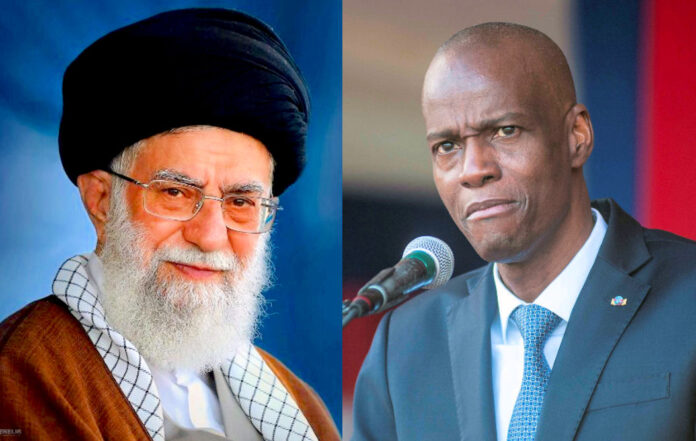
When the Trump administration takes part in the killing of Iran’s Supreme Leader Ali Hosseini Khamenei or sends the U.S. Army’s Delta Force to kidnap Venezuela’s President Nicolas Maduro, it is merely doing openly and visibly what all U.S. administrations practice behind the scenes: the projection of global power by any means necessary, even if it means violating international law.
And this is precisely where a crucial question arises: how can the United States orchestrate such complex and audacious operations around the world — targeted strikes, the arrest of heads of state, regime change — and at the same time claim that it did not participate in President Jovenel Moïse ‘s assassination on Jul. 7, 2021?
Officially, it was not the Trump administration, but the Biden administration; yet, the question is not so much who is in power, but rather recognizing that the strategic choices of U.S. foreign policy transcend party lines.
The structures of the “deep state,” the intelligence agencies, and the “military-financial-industrial complex” operate continuously, regardless of who occupies the White House.
This is a central point for understanding the Haitian paradox: since 1915, the United States has exercised direct or indirect control over the essential aspects of Haiti’s political, economic, and security life. Today, they claim to be asking the Haitian people to collaborate in “capturing certain gang leaders,” while they themselves are the historical actors best equipped to neutralize such forces on the ground.
Some argue that Washington, which is capable of eliminating and kidnapping heads of state abroad, has not killed or captured the leaders of the Viv Ansanm armed group coalition because they are somehow in cahoots with one another. This is a simplistic, facile, and even specious argument.
Right now, the U.S. empire is fighting wars on multiple fronts against Russia (in Ukraine), Palestine (via Israel), Yemen, Venezuela, Cuba, and now Iran. It has delegated the task of crushing the Viv Ansanm’s challenge to the de facto government (now headed by Prime Minister Alix Didier Fils-Aimé) to Erik Prince’s Vectus Global (formerly Blackwater), with some backup by the UN-blessed Gang Suppression Force (GSF). Both mercenary forces work closely with the Haitian National Police (PNH).
The principal person the U.S. wants to eliminate is former police officer Jimmy “Barbecue” Cherizier, for his ideology, his military training, his ability to unite two rival armed groups, to organize them, to make them understand that they serve the same cause, that they belong to the same social class, that their social interests are the same, and, moreover, that they share the same common enemy.
He has convinced them, against all odds, to stop fighting and join forces to struggle together against their common enemy: the (capitalist) “system” and its criminal, anti-national tentacles, namely the bourgeois oligarchy and the parasitic political class.
Imperialism quickly grasped the danger of Cherizier’s message and saw the need to prevent his class-based ideology from infecting the masses as a whole and leading them to rally to Viv Ansanm. This became exceptionally urgent after the Haitian people welcomed and applauded the armed coalition’s ouster of de facto Prime Minister Ariel Henry in February 2024. Seeing that he was a lost cause, the U.S. decided not to try to reinstall him.
Washington’s next step was to create the Transitional Presidential Council (CPT) and the Kenyan-headed Multinational Security Support (MSS) mission. Both dismally failed to establish peace and elections.
Trump’s Secretary of State Marco Rubio proposed that the GSF be a force over five times larger (5,500 troops) than the MSS, and much more autonomous, as well as partially UN funded. It has yet to reach those goals.
The massacres by drones and death-squads that Vectus Global, with the PNH and GSF, are carrying out in the Viv Ansanm neighborhoods are horrific. About 90% of those killed are innocent civilians. The armed groups are seasoned fighters who have tactics and experience to escape many attacks, so as in Gaza, the population is victim.
So, for the moment, as it fights other wars, Washington is using Erik Prince’s mercenaries to lead its battles in Haiti, although Rubio has said that the U.S. may deploy ground troops to Haiti sometime this year. This in violation of the 1987 Haitian Constitution and the UN Charter.
This highlights an immutable rule of imperialist geopolitics: professed morality is merely a veneer, a mask to justify actions that are primarily about control, domination, and terror.
Weapons, institutions, international law, even requests for cooperation, are instruments for translating and legitimizing instincts and interests. Beneath the veneer of democracy or humanitarianism, the reality remains the same: power is measured by what an actor can actually impose, not by the rules it claims to respect.
In short, whether it concerns Iran, Palestine, Venezuela, Cuba, or Haiti, the issue is not the Trump exception, nor the current president, but the ongoing and underlying structure of U.S. power, capable of acting on a global scale while dictating what it wants others to believe or do. And clarity on this truth is needed to understand Haiti’s recent history and the persistent cynicism and double standards of Haiti’s neocolonial masters.